NSW LearnerNSW DKT practice
Get NSW Learner free

Practise for the NSW driver knowledge test

General Knowledge

NSW road markings and line rules

In the test. Line and marking questions are general knowledge items on the DKT. A question describes a painted line or symbol and asks what you may do next: overtake, change lanes, stop or turn.

Quick answer

Can you cross a continuous white line in NSW?

Not to overtake. A single continuous centre line, double continuous lines, or a solid line on your side all ban overtaking across them. The exceptions: you may cross by the shortest route to get into or out of a side street or property, and to give a cyclist the legal passing gap when you can see far enough ahead. A broken line on your side lets you overtake when the way is clear.

The short version

  • A continuous centre line means no overtaking across it, cyclists aside
  • Where broken and solid lines run together, the one nearest you decides
  • Lane arrows set where you must go from that lane
  • Solid yellow along the kerb means no stopping, ever
  • Never stop on KEEP CLEAR, and keep off painted islands

Centre lines and overtaking

Two things decide every centre line question: the colour of the line and whether it is broken or solid.

  • Single broken line: overtake when the road ahead is clear and it is safe.
  • Single continuous line: no overtaking across it, from either side.
  • Double continuous lines: no overtaking from either direction.
  • Broken and continuous side by side: the line nearest you decides. Broken on your side means you may pass, solid on your side means you may not.
  • Beside a continuous centre line, hold your whole car to the left of it the entire time, round bends too. Wheels wandering over it on a curve count as an offence.
  • The one passing exception is a cyclist. To leave the legal gap you may go over any centre line, provided your view ahead is clear and it is safe.

Turning into a driveway or side road across a solid centre line is allowed by the shortest path, as long as it is safe.
Lane lines and arrows

Lines between lanes tell you whether you may move across, and arrows tell you where each lane must go.

  • Across a broken lane line you may move over, as long as you let vehicles already in that lane keep their place.
  • A continuous lane line means stay put until it becomes broken.
  • A painted arrow shows the direction you must take from that lane.
  • A combined arrow, such as straight and right, allows either direction it shows.
  • Keep the whole car inside one marked lane, except while you are changing lanes.

Lines painted across your lane

Lines running across the road tell you where to stop or give way.

  • A continuous line at a stop sign: stop just behind it, as close as you can.
  • A stop sign with no line painted: pull up just short of the intersection, as near to it as you can get.
  • A stop line with its sign knocked flat still means stop, then give way.
  • A broken line across your lane at an intersection: a give way line, which works like the sign.
  • KEEP CLEAR: leave the painted area empty, even in a queue, so side traffic can get out.
  • Green light but traffic banked up past the intersection: wait behind it until you can get right through.
  • Broken turn lines through an intersection mark the path your car should trace while turning.

A green light does not let you enter an intersection you would end up stuck in. Wait until there is room on the far side.

Yellow lines, islands and warning marks

A few markings carry extra meaning through their colour or pattern.

  • A continuous yellow edge line along the kerb means no stopping at any time.
  • Diagonal stripes framed by a solid line mark a painted island. Stay off it, with one exception: where a turning lane begins just after it, you may drive over a single solid edge for up to 50 metres to reach that lane.
  • Raised or planted median strips separate the two directions and must not be driven over.
  • Zig-zag lines along your lane warn that a pedestrian crossing is close.
  • White triangles painted along both edges of the lane, next to a school zone sign, show where the zone begins.
  • Raised reflectors in lane lines keep them visible at night and in rain.

Bus, transit and bicycle lanes

Special lanes are marked with words, symbols or signs, and each has its own rule while it operates.

  • Bus lane: a car may drive in it briefly to turn, or to get into or out of the road, while it operates.
  • Bus only lane: stricter again, reserved for buses.
  • Transit lane, such as T2: only vehicles carrying at least the number shown, driver included.
  • Bicycle lane: stay out, apart from brief entries the rules allow, for example to turn.
  • The sealed shoulder beyond a continuous white edge line is not a passing lane. Crossing that edge line is fine, though, when you turn into or out of a side street.

Try this

Worked examples to think through

Picture the situation, decide what you would do, then open the answer.

1Try this

A slow tractor is in front of you. Down the middle of the road runs a broken line paired with a continuous one, and the continuous line is the one on your side. Can you overtake?

Show the answer

No, stay behind the tractor. Crossing to pass is only allowed when the broken line is the one closer to you (rule 132).

2Try this

Traffic at the lights has stopped, and right in front of your bumper KEEP CLEAR is painted across the road outside a fire station. Where do you wait?

Show the answer

Behind the painted words, with the marked area left empty, even though that leaves a hole in the queue (rule 96).

Practise it

Three road markings questions to try

Real questions from the 66 in the NSW Learner bank for this topic, three options each like the test. Pick one to see the answer, the reason and the rule.

Question 1 of 3 General Knowledge

Traffic is crawling and KEEP CLEAR is painted across the lane just ahead. What must you do?

Right.Not quite. The answer is C.

A keep clear marking must be left free so traffic from a side road or driveway can get through.

Source: Road Rules 2014 (NSW) rule 96

Question 2 of 3 General Knowledge

The centre marking is a broken line next to a continuous line, and the broken line is closer to you. Can you overtake?

Right.Not quite. The answer is A.

You may cross when the broken line is on your side, as long as you have a clear view and room to finish safely.

Source: Road Rules 2014 (NSW) rule 132

Question 3 of 3 General Knowledge

BUSLANE

You are driving a car and see this sign over a lane during its operating hours. What is the rule?

Right.Not quite. The answer is A.

A bus lane is for buses and a few other permitted vehicles, and a car may only use it briefly to turn.

Source: Road Rules 2014 (NSW) rule 154

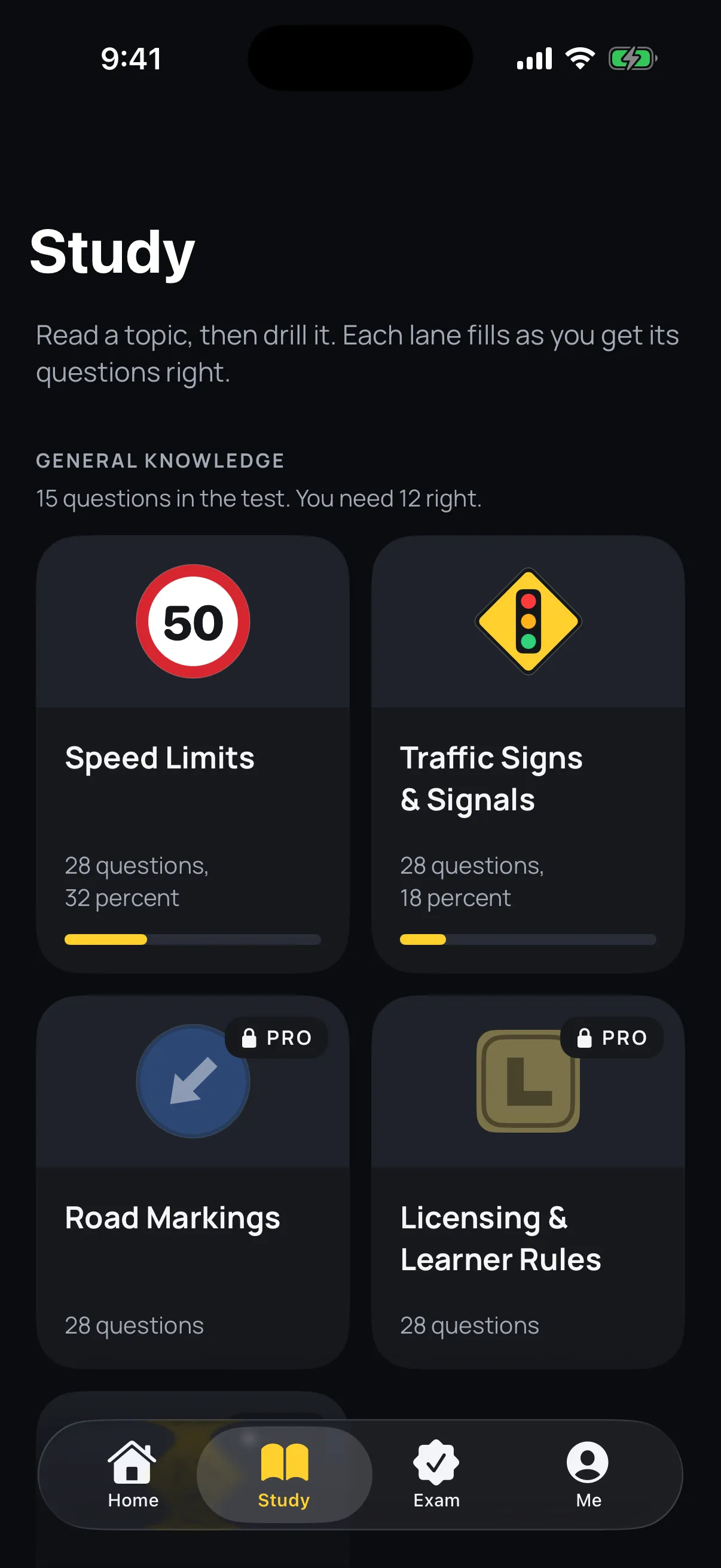
The NSW Learner Study tab with topic tiles, each with its drawn sign and a lane showing progress

Practise this topic in the app

Drill road markings until it is automatic

In NSW Learner this topic has its own lesson and a drill of 66 questions. Questions you miss come back sooner, the lane on the tile fills as you get them right, and the mock exam mixes it in with everything else in the test's layout.

Common questions

What does a yellow line on the side of the road mean in NSW?
It bans stopping at any time along that stretch of kerb, even for a quick drop off.
Can I cross double white lines to turn into a driveway?
Yes. You may cross them by the shortest route to enter or leave a driveway or side road, provided it is safe.
Who can drive in a T2 lane?
Any vehicle carrying at least two people, counting the driver, while the lane is operating.
Can I drive in a bus lane in NSW?
Only briefly, to turn or to get into or out of the road, during the lane's hours.
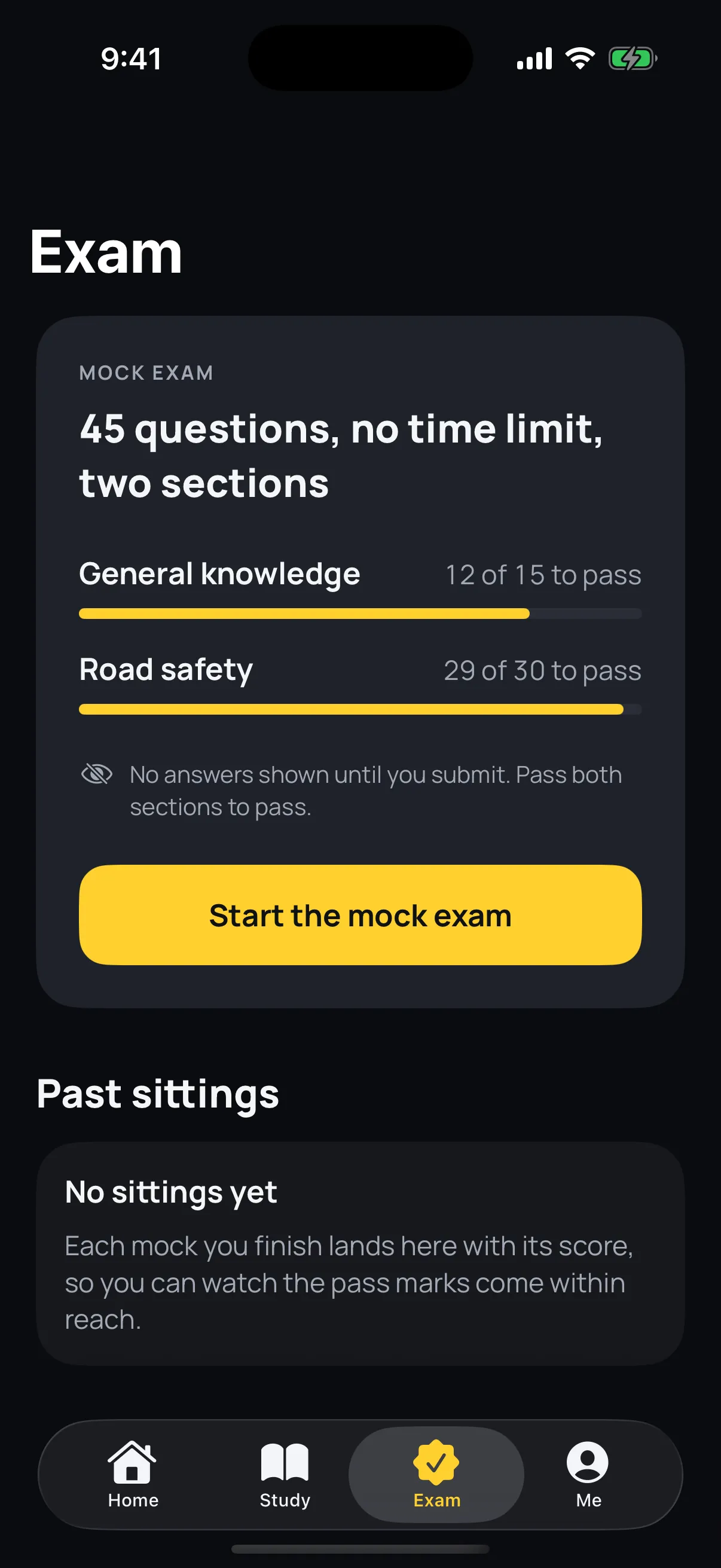
NSW Learner mock exam screen: 45 questions, no time limit, two sections with their pass marks
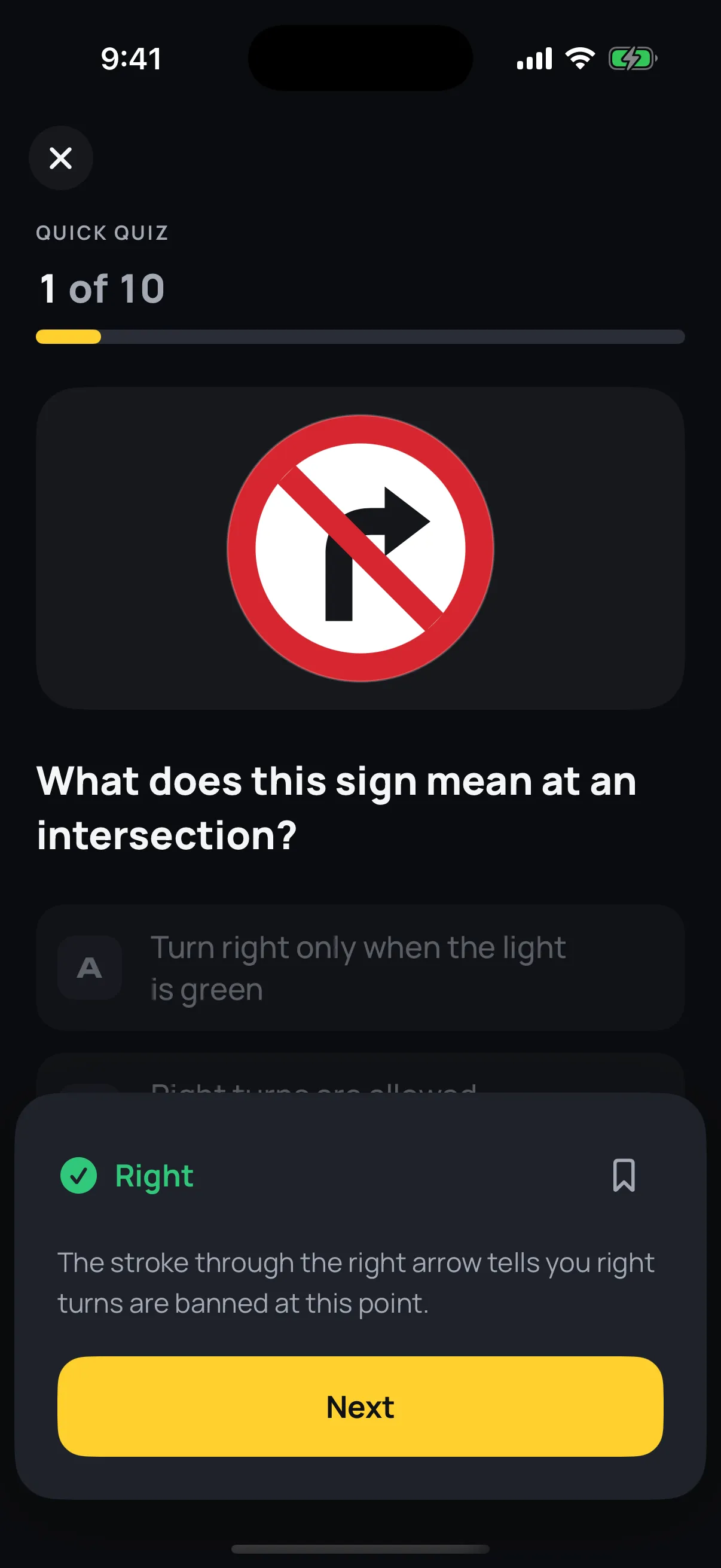
A practice question in NSW Learner answered correctly, with the explanation card
LP

Your L plate turns green when you would pass

NSW Learner is also an iPhone app, built on the same lessons and questions as this site. Short lessons for every topic, drills that bring back what you got wrong, and a mock exam in the test's layout, in your pocket and working without a signal.

  • Free in the app: one full mock exam, and the speed limits and traffic signs and signals topics with their lessons, drills and 179 questions
  • Private the app needs no account, works offline and keeps your progress on your phone
  • Pro comes two ways, each bought separately. NSW Learner Pro on this website is A$14.99 one-time and works in any browser you sign in on. The app has its own Pro, bought inside the app through Apple. One does not unlock the other.

Independent study app. Not affiliated with Transport for NSW or Service NSW.