NSW LearnerNSW DKT practice
Get NSW Learner free

Practise for the NSW driver knowledge test

Road Safety

NSW give way rules

In the test. Give way questions are the backbone of the DKT's road safety section, where you can only afford one wrong answer. Each sets a scene, such as leaving a car park or meeting a bus, and asks who goes first.

GIVEWAY

Quick answer

Who gives way at a T-intersection in NSW?

At an unsigned T-intersection, whoever is on the terminating road waits for all traffic on the through road, whichever direction it comes from. If you are on the through road and want to turn right into the side road, you still let oncoming traffic going straight or turning left go first. Pedestrians crossing the road you turn into also go before you.

The short version

  • Coming out of a driveway, road traffic and footpath users both go first
  • When you change lanes, the car already in the lane has priority
  • A stop sign or stop line needs a full stop, even on an empty road
  • Pedestrians on crossings and in shared zones always go first
  • Emergency vehicles get priority even against your green light

Signs, stop lines and give way lines

To give way is to let someone else go ahead of you safely. Sometimes that takes a stop, and sometimes only slowing.

  • At a give way sign with nobody around, you may keep moving after checking.
  • At a stop sign you stop completely, even on an empty road, and then give way.
  • A solid stop line with no sign has the same effect as a stop sign.
  • A broken line painted across your lane means the same as a give way sign.
  • A give way sign before a narrow bridge means vehicles already on it, or approaching from the opposite end, get it first.
Driveways, the kerb and your own lane

Many everyday give way questions happen nowhere near an intersection.

  • Leaving a driveway or car park: give way to traffic on the road and people on the footpath.
  • Turning left into a driveway: people walking along the footpath go first.
  • Turning right into a driveway: oncoming traffic and people on the footpath both go first.
  • Pulling out from the kerb: every vehicle on the road goes first, cyclists included.
  • Moving sideways within a wide lane, say around a parked car: a rider or driver already in that space has priority.
  • Making a U-turn: you give way to all vehicles and all pedestrians.

Lane changes, merges and painted islands

When lanes meet, whoever is already there usually wins.

  • Moving across a broken lane line: vehicles already in that lane have priority.
  • Two lines merging with no lane lines: the vehicle that is ahead goes first.
  • Your lane is ending: give way to traffic in the lane that continues.
  • Crossing a painted island into a turning lane: any car already in the turning lane goes first.
  • Crossing through a median gap, or waiting in a median turning bay: traffic on the road you cross or join goes first.

Give way at intersections

Here the shape of the junction and its signs set the order.

  • No signs or lights: the vehicle on your right goes first, whether you go straight or turn left.
  • At a T-intersection, traffic on the road that ends waits for the through road.
  • Turning right: oncoming traffic going straight or turning left goes before you.
  • Turning either way, including on a green circle: pedestrians crossing the road you enter go first.
  • A LEFT TURN ON RED PERMITTED AFTER STOPPING sign: come to a full stop first, then turn only once vehicles from the right and people crossing are clear.
  • Entering a roundabout: give way to everyone already circulating, bikes too.

Turning left as an oncoming car turns right into the same street? You go first.

People on foot

Pedestrians have priority in more places than many learners expect.

  • Anyone on a pedestrian crossing has priority, so stop and let them cross.
  • When the flags are out at a children's crossing, stay stopped while anyone is on it. A supervisor's hand-held STOP sign keeps you there until it comes down or you are waved through.
  • Flashing yellow at mid block pedestrian lights: anyone on the crossing goes first, and you may move off once it is empty.
  • In a shared zone, people on foot have priority wherever they walk.
  • Away from any crossing, a person on the road still gets your care: slow down or stop so you do not hit them.

Emergency vehicles, police, buses, trams and trains

Some road users get priority because of the job they do.

  • Emergency vehicles sounding a siren or showing flashing blue or red lights, even just one of the two: never pull out ahead of them, make room when safe, and let them through on your green.
  • A police officer directing traffic overrides the lights, so follow their direction.
  • Do not cut into or drive through a funeral procession.
  • In a built-up area, let a bus with a give way to buses sign pull out from a stop when it signals.
  • Keep clear of trams in tram lanes, and at a level crossing with a give way sign, let any train go first.

Try this

Worked examples to think through

Picture the situation, decide what you would do, then open the answer.

1Try this

You are driving out of a shopping centre car park. Someone pushing a pram is crossing the exit on the footpath, and a car is approaching along the street. Who has priority?

Show the answer

They both do. Coming out of a car park or driveway, you let footpath users and road traffic go before you (rule 74).

2Try this

Your lane and the one beside it squeeze into one, with no lane lines to guide you. The other car is slightly in front. Who goes first?

Show the answer

The car in front. When lanes join without markings, the vehicle ahead has the right of way, so drop back a little and merge in behind it (rule 149).

Practise it

Three give way rules questions to try

Real questions from the 45 in the NSW Learner bank for this topic, three options each like the test. Pick one to see the answer, the reason and the rule.

Question 1 of 3 Road Safety

You are driving out of a shopping centre car park onto the street. Who must you give way to?

Right.Not quite. The answer is A.

When you enter a road from a car park or driveway, everyone already on the road and footpath goes first.

Source: Road Rules 2014 (NSW) rule 74

Question 2 of 3 Road Safety

At a crossroad with no signs or lights you are turning left. A car approaching from your right is going straight ahead. Who goes first?

Right.Not quite. The answer is B.

A driver turning left at an intersection without signs or signals gives way to any vehicle approaching from the right.

Source: Road Rules 2014 (NSW) rule 72

Question 3 of 3 Road Safety

At an intersection without signs, you are turning left and an oncoming car is turning right into the same street. Who goes first?

Right.Not quite. The answer is B.

A right turning driver gives way to oncoming vehicles turning left, so the left turn goes first.

Source: Road Rules 2014 (NSW) rule 72

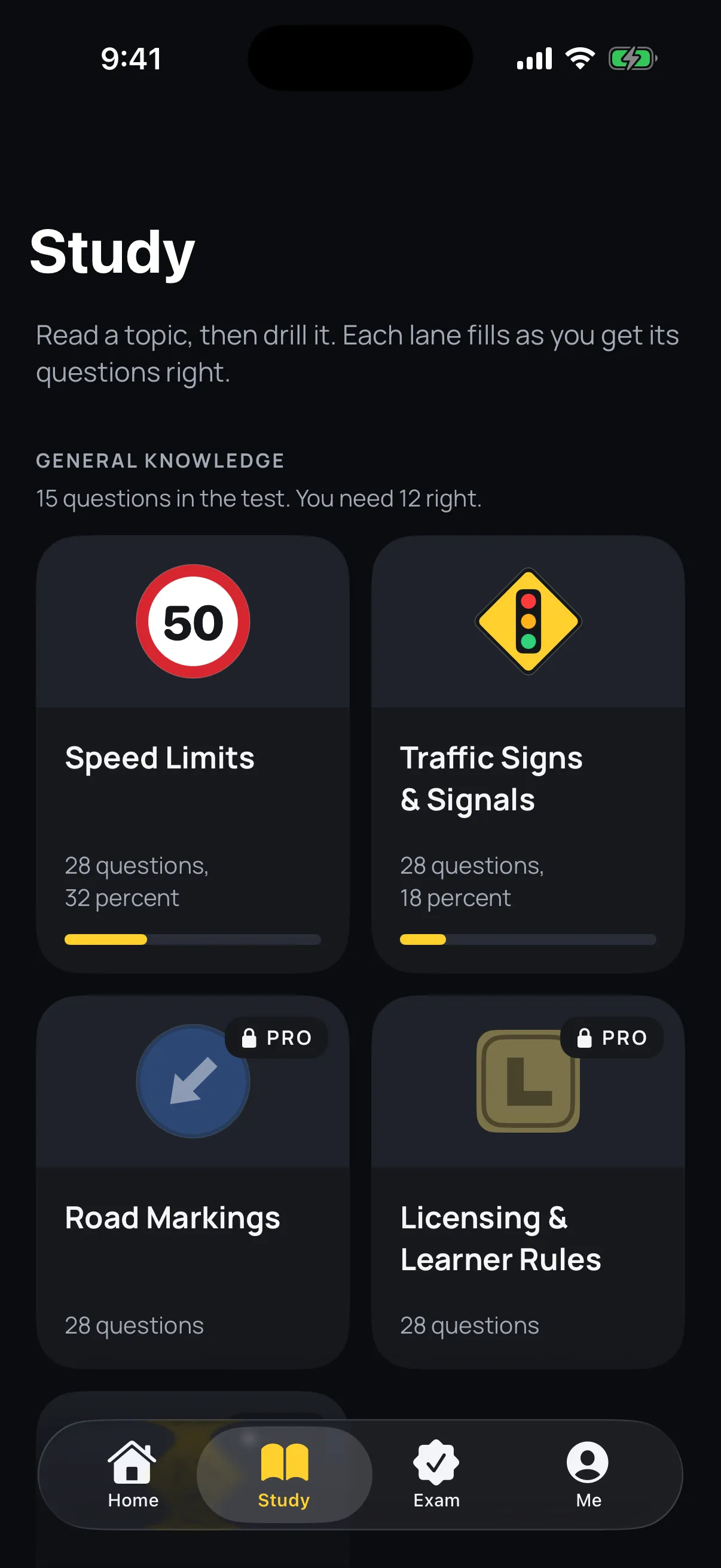
The NSW Learner Study tab with topic tiles, each with its drawn sign and a lane showing progress

Practise this topic in the app

Drill give way rules until it is automatic

In NSW Learner this topic has its own lesson and a drill of 45 questions. Questions you miss come back sooner, the lane on the tile fills as you get them right, and the mock exam mixes it in with everything else in the test's layout.

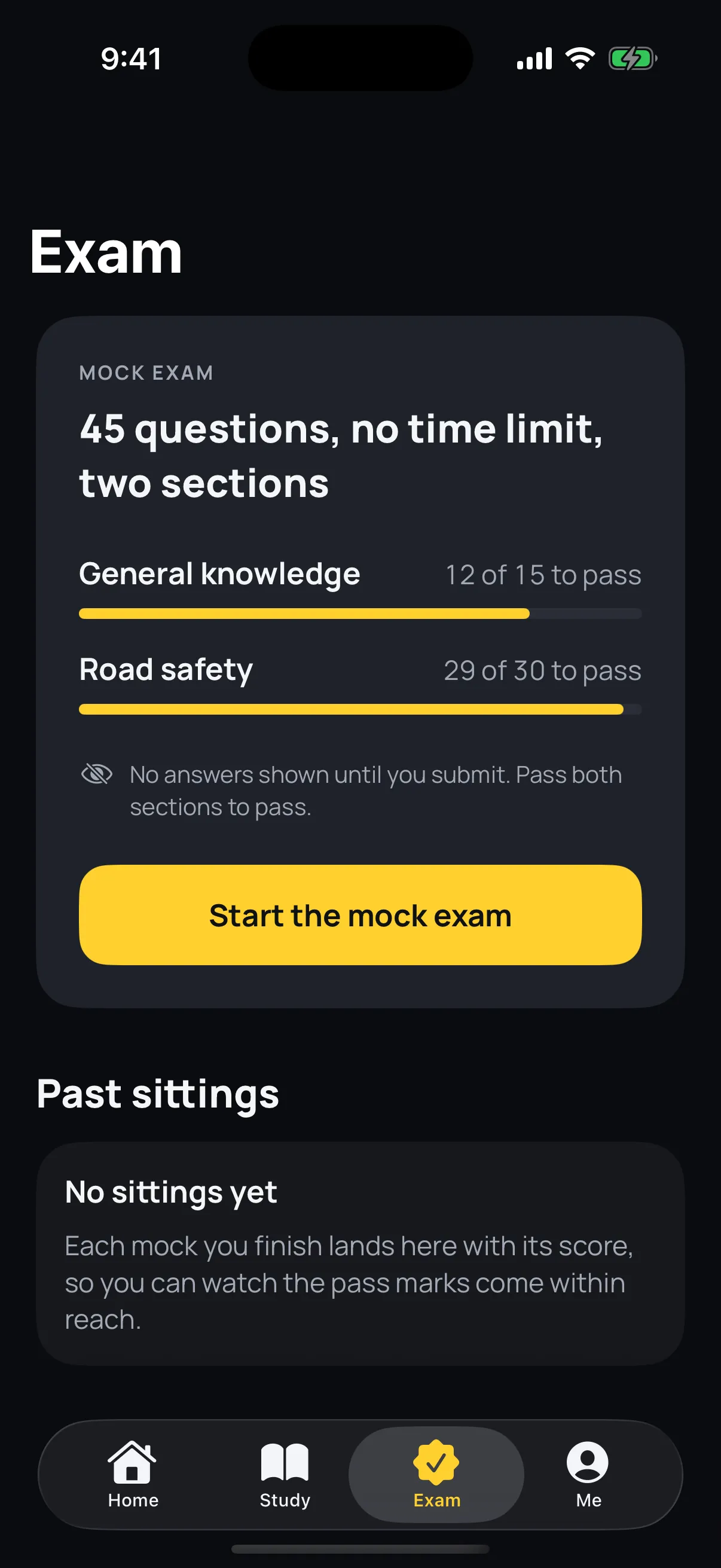
NSW Learner mock exam screen: 45 questions, no time limit, two sections with their pass marks
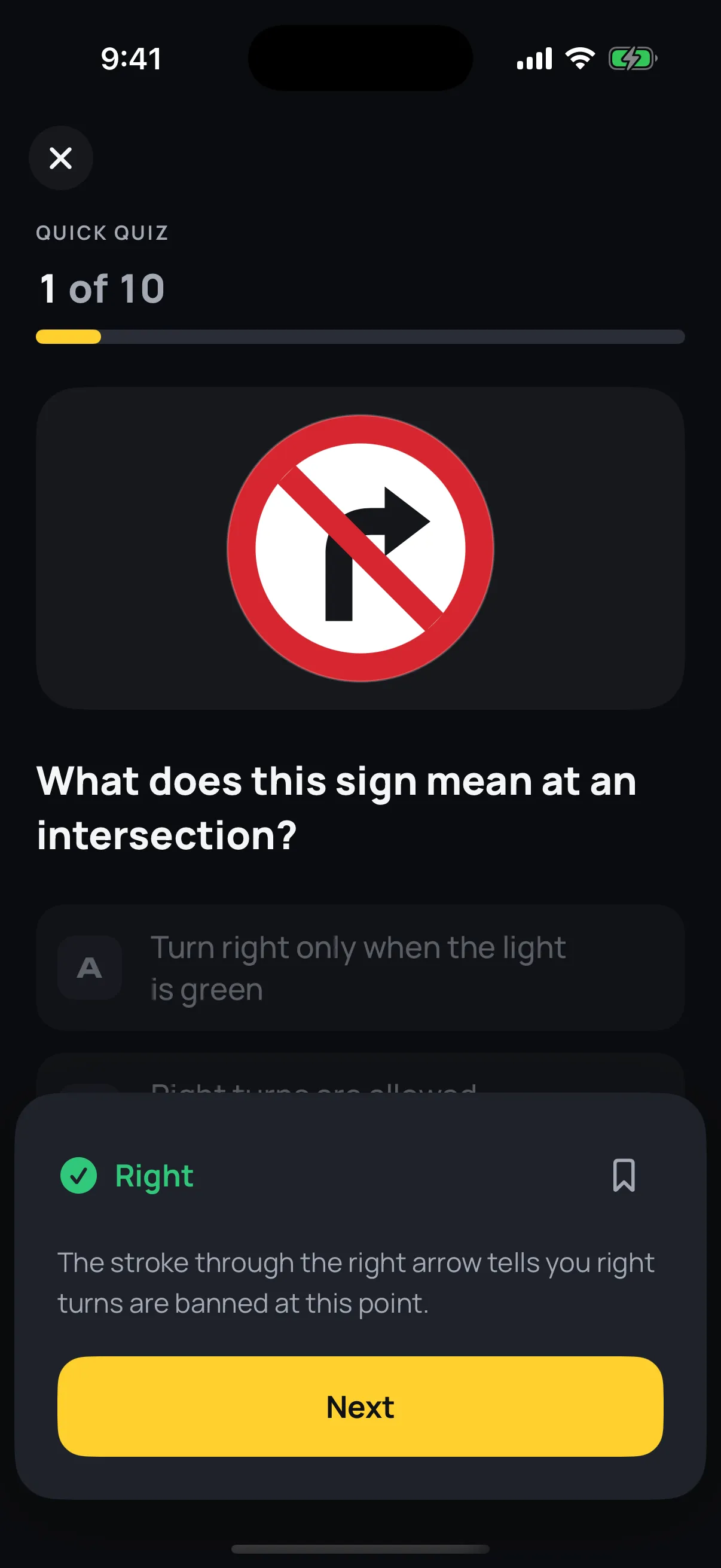
A practice question in NSW Learner answered correctly, with the explanation card
LP

Your L plate turns green when you would pass

NSW Learner is also an iPhone app, built on the same lessons and questions as this site. Short lessons for every topic, drills that bring back what you got wrong, and a mock exam in the test's layout, in your pocket and working without a signal.

  • Free in the app: one full mock exam, and the speed limits and traffic signs and signals topics with their lessons, drills and 179 questions
  • Private the app needs no account, works offline and keeps your progress on your phone
  • Pro comes two ways, each bought separately. NSW Learner Pro on this website is A$14.99 one-time and works in any browser you sign in on. The app has its own Pro, bought inside the app through Apple. One does not unlock the other.

Independent study app. Not affiliated with Transport for NSW or Service NSW.